
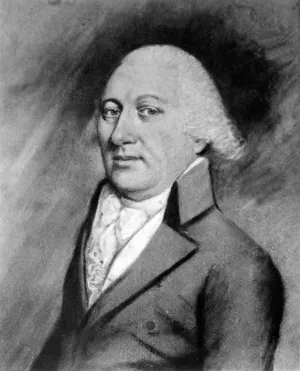
John Langdon of New Hampshire helped finance the Revolutionary War and served as a naval captain during the conflict. He was a delegate to the Constitutional Convention and signed the U.S. Constitution as one of New Hampshire’s representatives. Over the course of his public career, he served as a U.S. Senator, President (Governor) of New Hampshire, and held various other key offices in both state and national government.
Early Life
John Langdon was born on June 26, 1741, in Portsmouth, New Hampshire. He received a grammar school education and apprenticed with a local merchant before entering the shipping trade. Langdon eventually built a successful mercantile business and one of the most prominent merchant fleets in the American colonies.
Langdon opposed British colonial policies that adversely affected the merchant class, including the Navigation Acts and restrictions on colonial shipping. In December 1774, he joined other New Hampshire patriots in the raid on Fort William and Mary (in what is now New Castle). This act—often cited as one of the earliest armed engagements of the American Revolution—secured valuable gunpowder and cannons later used in the Siege of Boston, including at the Battle of Bunker Hill.
Public Office
Langdon was elected to the last Royal Assembly of New Hampshire and then to the Second Continental Congress in 1775 and 1776. He resigned in mid-1776 to become the continental agent for maritime prizes and oversaw the construction of warships for the Continental Navy. One of these vessels, the Raleigh, was built in Portsmouth and launched in 1776.
In 1777, Langdon used his personal funds to finance the militia expedition of General John Stark against British forces under General Burgoyne. The resulting Battle of Bennington was a key victory for the American cause. Langdon did not command troops at Saratoga or Rhode Island—those engagements involved other officers—but he played a vital logistical and financial role in New Hampshire’s wartime mobilization.
Langdon served as Speaker of the New Hampshire House of Representatives from 1777 to 1781 and again in later years. He returned briefly to the Continental Congress in 1783.
Constitutional Convention
Langdon was appointed as a delegate to the Federal Constitutional Convention of 1787, although New Hampshire was initially reluctant to fund its delegates. Langdon advanced the funds for himself and Nicholas Gilman to attend. He arrived in July 1787, and while he was not among the most vocal members, he participated in the debates and signed the U.S. Constitution on September 17, 1787. Delegate William Pierce of Georgia described Langdon as “a Man of considerable fortune, possesses a liberal mind, and a good plain understanding.”
Role in New Government
Langdon served as President (Governor) of New Hampshire under the state’s pre-Constitution government in 1785 and 1788–1789. He was then elected to the United States Senate in the first federal Congress in 1789 and served until 1801. During his Senate tenure, he was chosen as the first President pro tempore of the Senate in 1792, a position held by the senior senator in the absence of the Vice President.
In 1801, President Thomas Jefferson offered Langdon the post of Secretary of the Navy, which he declined. He returned to state politics and was elected again to the New Hampshire legislature and later as Governor of New Hampshire, serving from 1805 to 1809, and again from 1810 to 1812.
In 1812, Langdon declined the Democratic-Republican nomination for Vice President, which would have placed him on the ticket with James Madison. The nomination eventually went to Elbridge Gerry.
Later Life
After retiring from public life in 1812, Langdon returned to Portsmouth, where he focused on civic and religious affairs. He died on September 18, 1819, and is buried in Old North Cemetery in Portsmouth, New Hampshire.