
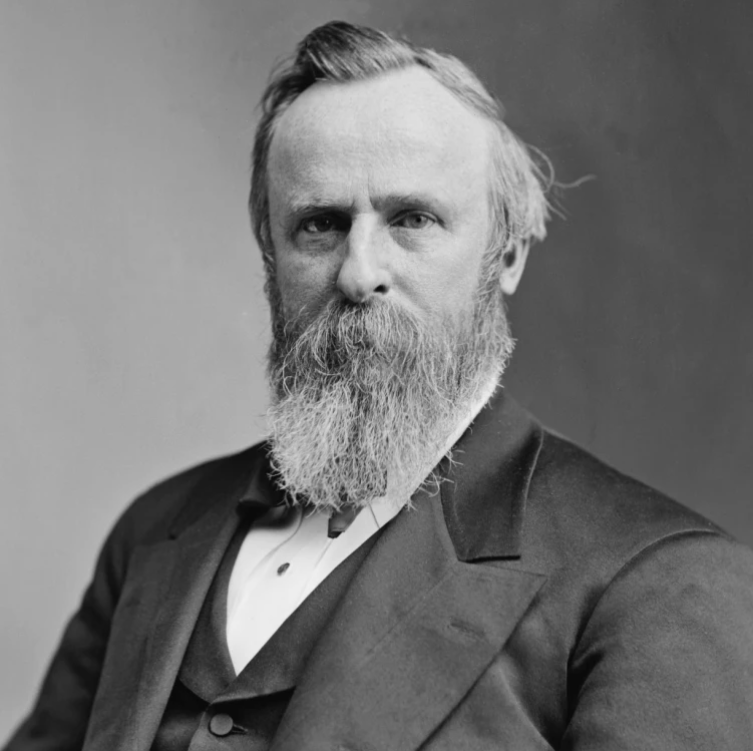
President Rutherford Hayes was the 19th president of the United States, serving from 1877-1881. Hayes oversaw the end of Reconstruction after the Civil War.
Early Life
Rutherford Hayes was born in October, 1822, in Delaware, Ohio. Hayes studied in local common schools and then a preparatory school in Connecticut. He attended Kenyon College in Ohio and graduated as the class valedictorian. He read the law in Columbus for a brief period, and then moved to Boston to attend Harvard Law School. Hayes was admitted to the Ohio bar in 1845 and opened his own office in Fremont. A few years later, he moved his office to Cincinnati. There, he met and married his wife, Lucy Webb. They had eight children together, seven sons and one daughter. Three of their sons died in infancy.
As a lawyer, Hayes concentrated on criminal defense issues, representing clients accused of murder. Hayes was also a staunch abolitionist, and he defended former slaves who had escaped and been accused under the Fugitive Slave Act of 1850.
Political Life
Hayes’s work on behalf of escaping slaves raised his profile in the Republican party. In 1858, Hayes filled the vacant position of the city solicitor, and was elected to the position in 1859. When the Civil War began, Hayes joined the 23rd Regiment of Ohio Voluntary Infantry. He served first as a major, next as lieutenant colonel, and later brigadier general.
Hayes was nominated for the U.S. House of Representatives in 1864. He refused the nomination, refusing to abandon the army to campaign. Despite this, he won the election, and joined the 39th Congress in December of 1865. In Congress, Hayes worked to pass Reconstruction legislation. He voted in favor of the Fourteenth Amendment and worked with other Republican congressmen to reject President Andrew Johnson’s Confederate-sympathetic Reconstruction Plan. The 39th Congress also passed the Civil Rights Act of 1866. Hayes resigned in 1867 to run for governor of Ohio.
Hayes was elected to governor in 1868 and held office for two terms, until 1872. Hayes oversaw the establishment of a school for deaf-mutes and a reform school for girls. He advocated on behalf of the impeachment of President Andrew Johnson, which was unsuccessful by one vote. Hayes was a proponent of equal rights for black Ohioans and ensured that the Fifteenth Amendment was ratified in Ohio. Hayes hoped to retire from politics in 1872, but he was nominated for governor again in 1875. He was elected for a third term in 1875.
Presidency
Hayes won the Republican nomination for presidency. The election was very close, and Hayes’s opponent, Samuel Tilden, won the popular vote. However, Republican leaders challenged the results, believing fraud and voter suppression of blacks took place. There were twenty disputed electoral votes, and an Electoral Commission was formed to determine their fate. Hayes ultimately won the electoral vote by a margin of 185-184. Many Democrats believed that Hayes’s election was illegitimate and referred to him as “Rutherfraud” or “His Fraudulency.”
Hayes tried to protect the rights of southern blacks and rebuild Republican strength in the South. These attempts were unsuccessful, as were President Hayes’s other attempts to have the South accept legal racial equality. Hayes also failed to convince Congress to appropriate funds to enforce civil rights laws.
President Hayes also gave attention to reforming the civil service appointment system. President Jackson had instituted a spoils system, awarding these jobs to political supporters. Hayes sought to end this by requiring a merit exam. He was unsuccessful in convincing Congress to pass this legislation but was able to issue an executive order forbidding federal office holders from being required to make campaign contributions.
The Great Railroad Strike took place in 1877 and was one of the largest labor uprisings in U.S. history. More than 100,000 workers participated, protesting their reduction in pay by walking off the job. The protests began in West Virginia, but quickly spread to Baltimore, Pittsburgh, Albany, Buffalo, Chicago, and St. Louis. President Hayes ordered troops to assist the suppression of riots in Baltimore and Pittsburgh. This would be the first time federal troops were used to break a strike against a private company.
Post-Presidency
Hayes declined to run for a second term and returned to Ohio in 1881. Hayes devoted his time to educational charities, serving on the Board of Trustees of Ohio State University. Hayes believed that education was a vital part of society. He urged black students to apply for scholarships, and lobbied Congress to pass a bill that would allow federal aid for education. Hayes died in 1890.