
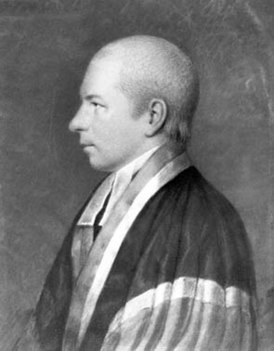
William Paterson of New Jersey was a pivotal figure in the formation of the United States Constitution and a lifelong public servant who helped shape both state and national institutions. A delegate to the Constitutional Convention and author of the New Jersey Plan, Paterson also served as a U.S. Senator, Governor of New Jersey, and Associate Justice of the United States Supreme Court.
Early Life
William Paterson was born on December 24, 1745, in County Antrim, Ireland, and immigrated with his family to the American Colonies as a young child, settling in New Jersey. Raised in a family that valued education and civic engagement, Paterson entered the College of New Jersey (now Princeton University) at age 14 and graduated in 1763 at 18. He studied law under the prominent attorney Richard Stockton and was admitted to the bar in 1768, shortly thereafter establishing a respected law practice in New Bromley, Hunterdon County, and later in Raritan, Somerset County.
As the Colonies moved toward revolution, Paterson became an active supporter of colonial rights, aligning with the Patriot cause. He emphasized the need for legal structure and order in the pursuit of independence, a perspective that would shape his contributions during and after the American Revolution.
Public Office
Paterson’s political career began with his election as a delegate to the First Provincial Congress of New Jersey in 1775, where he was named secretary. He soon rose to prominence, serving as the first Attorney General of New Jersey from 1776 to 1783. In this role, he helped implement New Jersey’s 1776 Constitution and managed legal affairs during the Revolutionary War, including prosecutions and legal transitions from colonial to independent governance.
After stepping down as attorney general in 1783, Paterson returned to private law practice but remained influential in New Jersey politics. His commitment to well-defined state sovereignty would become a defining theme in his role at the Constitutional Convention.
Constitutional Convention
In 1787, Paterson was selected as one of New Jersey’s delegates to the Federal Constitutional Convention in Philadelphia. He became a leading voice for the interests of smaller states, introducing the New Jersey Plan as a counter to the Virginia Plan. His proposal called for a unicameral legislature in which each state, regardless of population, would have equal representation—a safeguard against domination by more populous states.
Although the New Jersey Plan was ultimately rejected, it played a crucial role in shaping the eventual Connecticut Compromise (or Great Compromise), which established a bicameral legislature with proportional representation in the House and equal representation in the Senate. Paterson remained a consistent and influential voice throughout the Convention and was one of the thirty-nine signers of the U.S. Constitution.
Role in New Government
Following ratification of the Constitution, Paterson was elected as one of New Jersey’s first United States Senators, serving from 1789 until 1790. While in the Senate, he contributed to the drafting and passage of the Judiciary Act of 1789, a landmark law that established the structure of the federal judiciary, including the Supreme Court and the system of lower federal courts.
In 1790, Paterson resigned from the Senate upon being elected Governor of New Jersey, a position he held until 1793. As governor, he worked to align state law with the new federal Constitution and implemented several legal and administrative reforms.
In 1793, President George Washington appointed Paterson as an Associate Justice of the United States Supreme Court. He served with distinction on the Court until his death in 1806. While the concept of judicial review was not formally established until Marbury v. Madison in 1803 (after which Paterson remained on the bench), his opinions helped lay the groundwork for the role of the judiciary in interpreting the Constitution.
Later Life and Legacy
Justice Paterson remained on the Supreme Court until health issues began to take their toll in the early 1800s. In 1803, he moved to Albany, New York, to live with his daughter and son-in-law, Stephen Van Rensselaer III. He died there on September 9, 1806, at the age of 60. His remains were originally interred at Van Rensselaer Manor but were later reinterred at Albany Rural Cemetery.
William Paterson’s legacy is firmly embedded in American history—as a framer of the Constitution, a defender of small-state representation, and a founder of American jurisprudence. His name endures through the city of Paterson, New Jersey, and William Paterson University, both named in his honor.