
Constitutional Law Reporter
Award
Menu
  • Home
  • US Constitution
  • Supreme Court Cases
  • Justices
    • Chief Supreme Court Justices
    • Current Supreme Court Justices
    • Past US Supreme Court Justices
  • American Biographies
    • General
    • Presidents
    • Vice-Presidents
    • First Ladies
    • Signers of the U.S. Constitution
    • Signers of the Declaration of Independence
    • Delegates of the U.S. Constitution
    • Misc – Great American Bios
  • Articles
    • Current Cases
    • Historical Cases
    • Impeachment
  • Videos
  • Links
Hot-Topics

May 26, 2026 | Divided Supreme Court Strikes Down Louisiana Redistricting Map

A B C D E F G H I J K L M N O P Q R S T U V W X Y Z
<< Back

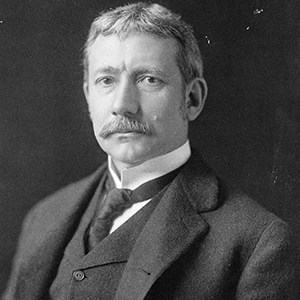
Elihu Root

Elihu Root

Elihu Root served twice as the Secretary of War and once as the Secretary of State. Winner of the 1912 Nobel Peace Prize, Root is widely regarded as one of the most brilliant administrators in U.S. history.

Early Life

Root was born in New York in 1845. After graduating from New York University School of Law and obtaining admission to the bar, Root developed a very successful private law practice through which he advised banks, railroads, and other prominent businesses. Although Root had no prior public service or military experience, President William McKinley asked him to serve as his Secretary of War.

Service as Secretary of War

Root accepted the position to represent “the greatest of all our clients, the government of our country.” In his post, Root modernized the War Department. He created the War College, expanded West Point, strengthened oversight over the National Guard, and solidified the overall structure of the department. Root also helped reshape U.S. policy regarding its colonies, favoring an approach that protected local customs and preserved a level of self-determination. Henry L. Stimson, who later served as secretary of war, stated that “no such intelligent, constructive, and vital force” had ever held the position in U.S. history.

Service as Secretary of State

In 1905, President Theodore Roosevelt asked Root to serve as Secretary of State following the death of John Hay. Upon assuming the position, he traveled to South America to smooth relations with both Cuba and Columbia. In 1907, he also successfully arbitrated a dispute between France and Germany over interests in Morocco. Roots’ other significant accomplishments as Secretary of State included eliminating patronage from the Foreign Service and Consular Service by implementing the first Foreign Service Exam. He also reshaped the State Department by creating a system of rotating diplomatic service members to diversify their experience and structuring the agency into geographic regions.

 Later Life

Root later served in the U.S. Senate from 1909 to 1915. Upon returning to private practice, he continued to play a prominent role in establishing international arbitration, including the Central American Court of Justice and the International Court of Justice.


Previous Articles

Unanimous Court Rules NJ Faith-based Pregnancy Centers Can Challenge Subpoenas for Donor Info
by DONALD SCARINCI on May 18, 2026
Unanimous Court Rules NJ Faith-based Pregnancy Centers Can Challenge Subpoenas for Donor Info

In First Choice Women’s Resource Centers, Inc. v. Davenport, 608 U.S. ____ (2026), the U.S. Supre...

Read More
Supreme Court Rules Police Officer Entitled to Immunity in Excessive Force Case
by DONALD SCARINCI on May 13, 2026
Supreme Court Rules Police Officer Entitled to Immunity in Excessive Force Case

In Zorn v. Linton, 607 U.S. ____ (2026), the U.S. Supreme Court held that a police officer was enti...

Read More
SCOTUS Rules Abscondment Doesn’t Toll Term of Supervised Release
by DONALD SCARINCI on May 11, 2026
SCOTUS Rules Abscondment Doesn’t Toll Term of Supervised Release

In Rico v. United States, 607 U.S. ___ (2026), the U.S. Supreme Court held that the Sentencing Refo...

Read More
All Posts

The Amendments

  • Amendment1
    • Establishment ClauseFree Exercise Clause
    • Freedom of Speech
    • Freedoms of Press
    • Freedom of Assembly, and Petitition
    Read More
  • Amendment2
    • The Right to Bear Arms
    Read More
  • Amendment4
    • Unreasonable Searches and Seizures
    Read More
  • Amendment5
    • Due Process
    • Eminent Domain
    • Rights of Criminal Defendants
    Read More

Preamble to the Bill of Rights

Congress of the United States begun and held at the City of New-York, on Wednesday the fourth of March, one thousand seven hundred and eighty nine.

THE Conventions of a number of the States, having at the time of their adopting the Constitution, expressed a desire, in order to prevent misconstruction or abuse of its powers, that further declaratory and restrictive clauses should be added: And as extending the ground of public confidence in the Government, will best ensure the beneficent ends of its institution.

Read More

More Recent Posts

  • Supreme Court Clarifies Applicability of First Step Act to Vacated Sentences
  • SCOTUS Rules E-Cigarette Retailers Can Challenge FDA Order in Fifth Circuit
  • Supreme Court Expands Judicial Review of Agency Actions
  • Supreme Court Pauses Order Reinstating CPSC Commissioners

Constitutional Law Reporter Twitter

A Twitter List by S_H_Law

Constitutional Law Reporter RSS

donald scarinci constitutional law attorney

Editor

Donald Scarinci

Managing Partner

Scarinci Hollenbeck

(201) 806-3364

Awards


Follow me

© 2018 Scarinci Hollenbeck, LLC. All rights reserved.

Prior results do not guarantee a similar outcome. Attorney Advertising