
Constitutional Law Reporter
Award
Menu
  • Home
  • US Constitution
  • Supreme Court Cases
  • Justices
    • Chief Supreme Court Justices
    • Current Supreme Court Justices
    • Past US Supreme Court Justices
  • American Biographies
    • General
    • Presidents
    • Vice-Presidents
    • First Ladies
    • Signers of the U.S. Constitution
    • Signers of the Declaration of Independence
    • Delegates of the U.S. Constitution
    • Misc – Great American Bios
  • Articles
    • Current Cases
    • Historical Cases
    • Impeachment
  • Videos
  • Links
Hot-Topics

November 27, 2025 | SCOTUS Adds Second Amendment Case to Docket

A B C D E F G H I J K L M N O P Q R S T U V W X Y Z
<< Back

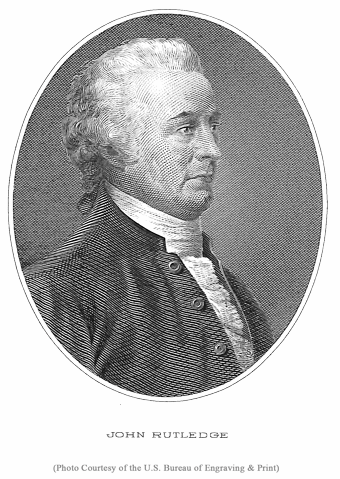
John Rutledge

John Rutledge lived between 1739 and 1800, and served as a politician, governor and judge during the formative years of the United States.

Rutledge was both a witness and participant in the establishment and signing of both the Declaration of Independence and U.S. Constitution and eventually became the second Supreme Court Chief Justice to serve in the United States.

Early history

Rutledge was born in Charleston, South Carolina, in 1739 and took a strong interest in law from an early age. He later attended Inns of Court in England, where he won two cases in the English court system during his tenure as a student. Upon returning from England, Rutledge successfully practiced law, and become involved in pre-revolutionary politics in 1765 when he chaired a committee that urged the English House of Lords to reject the Stamp Act. Although the measure was unsuccessful, it served as Rutledge’s first act of political involvement.

Political office

In 1774, Rutledge became a delegate to First Continental Congress and was elected as President of South Carolina in 1776. He resigned from this post in 1778 after refusing to sign a new state constitution that he believed would turn the state into a direct democracy and lead to chaos.

He was elected to lead South Carolina again in 1779 after the state constitution was revised and changed the title from “President” to “Governor.” After his term ended in 1782, he was again elected to the Continental Congress until 1783.

Supreme Court Justice

President George Washington nominated Rutledge to be an Associate Justice in 1789, however he resigned the post in 1791 to become Chief Justice of the South Carolina Supreme Court until 1795. He was nominated again by Washington to become the country’s second Chief Justice of the United States in 1795, where he held a recess position for four months. However, the Senate refused to confirm him.

During his short four-month tenure, he decided on two cases. In United States v. Peters, it was decided that the U.S. had no jurisdiction over crimes committed against Americans in international waters. In Talbot v. Janson, the Court ruled that Americans who gain citizenship of another country or renounce state citizenship do not waive their U.S. citizenship status.

Later life

After the Senate refused to confirm him, Rutledge retired from public life and died in 1800.

In addition to setting a precedent over multiple citizenship that is still relevant today, Rutledge also served as a founding trustee at the College of Charleston.


Previous Articles

Key Takeaways from Oral Arguments in Court’s Controversial Voting-Rights Case
by DONALD SCARINCI on November 12, 2025

The U.S. Supreme Court recently heard oral arguments in Louisiana v. Callais, which involves a key ...

Read More
Key Cases to Watch During the Supreme Court’s November Sitting
by DONALD SCARINCI on November 5, 2025

The U.S. Supreme Court’s November sitting begins on November 3 and concludes on November 12, 2025...

Read More
SCOTUS Clears Way to Terminate Protected Status for Venezuelan Nationals
by DONALD SCARINCI on October 29, 2025

On October 3, 2025, the U.S. Supreme Court granted an emergency request from the Trump Administrati...

Read More
All Posts

The Amendments

  • Amendment1
    • Establishment ClauseFree Exercise Clause
    • Freedom of Speech
    • Freedoms of Press
    • Freedom of Assembly, and Petitition
    Read More
  • Amendment2
    • The Right to Bear Arms
    Read More
  • Amendment4
    • Unreasonable Searches and Seizures
    Read More
  • Amendment5
    • Due Process
    • Eminent Domain
    • Rights of Criminal Defendants
    Read More

Preamble to the Bill of Rights

Congress of the United States begun and held at the City of New-York, on Wednesday the fourth of March, one thousand seven hundred and eighty nine.

THE Conventions of a number of the States, having at the time of their adopting the Constitution, expressed a desire, in order to prevent misconstruction or abuse of its powers, that further declaratory and restrictive clauses should be added: And as extending the ground of public confidence in the Government, will best ensure the beneficent ends of its institution.

Read More

More Recent Posts

  • Supreme Court Clarifies Applicability of First Step Act to Vacated Sentences
  • SCOTUS Rules E-Cigarette Retailers Can Challenge FDA Order in Fifth Circuit
  • Supreme Court Expands Judicial Review of Agency Actions
  • Supreme Court Pauses Order Reinstating CPSC Commissioners

Constitutional Law Reporter Twitter

A Twitter List by S_H_Law

Constitutional Law Reporter RSS

donald scarinci constitutional law attorney

Editor

Donald Scarinci

Managing Partner

Scarinci Hollenbeck

(201) 806-3364

Awards


Follow me

© 2018 Scarinci Hollenbeck, LLC. All rights reserved.

Prior results do not guarantee a similar outcome. Attorney Advertising