
Constitutional Law Reporter
Award
Menu
  • Home
  • US Constitution
  • Supreme Court Cases
  • Justices
    • Chief Supreme Court Justices
    • Current Supreme Court Justices
    • Past US Supreme Court Justices
  • American Biographies
    • General
    • Presidents
    • Vice-Presidents
    • First Ladies
    • Signers of the U.S. Constitution
    • Signers of the Declaration of Independence
    • Delegates of the U.S. Constitution
    • Misc – Great American Bios
  • Articles
    • Current Cases
    • Historical Cases
    • Impeachment
  • Videos
  • Links
Hot-Topics

November 27, 2025 | SCOTUS Adds Second Amendment Case to Docket

A B C D E F G H I J K L M N O P Q R S T U V W X Y Z
<< Back

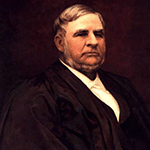
David Davis

David Davis (1862-1877)

Lived from 1815 to 1886.

Early Years and Legal Career

Davis was born on March 9, 1815 to a wealthy family in Cecil County, Maryland. He attended Kenyon College in Gambier, Ohio, graduating in 1832. Following college, Davis studied law at Yale University. After graduating from Yale in 1835, Davis moved to Bloomington, Illinois and began practicing law.

In 1845, Davis served as a member of the Illinois House of Representatives and, two years later, as a delegate to the Illinois constitutional convention in McLean County. From 1848 to 1862, he presided over the court of the Illinois Eighth Circuit–the same circuit in which attorney Abraham Lincoln was practicing. Notably, Davis would later serve as Lincoln’s campaign manager during the 1860 presidential election. Following Lincoln’s assassination, Davis was also an administrator of his estate.

Appointment to the Supreme Court

On October 17, 1862, President Lincoln appointed Davis to a seat on the United States Supreme Court. He was confirmed by the U.S. Senate on December 8, 1862, and received his commission the same day. Davis was famous for writing one of the most profound decisions in the Court’s history, Ex Parte Milligan. In that case, the court set aside a death sentence imposed during the Civil War by a military commission upon a civilian, Lambdin P. Milligan, who had been found guilty of inciting insurrection. The Court held that since the civil courts were operative, the trial of a civilian by a military tribunal was unconstitutional.

Davis refused several calls to become Chief Justice. A registered independent, Davis was nominated for President by the Labor Reform Convention in February 1872. However, he withdrew from the presidential contest after he failed to receive the Liberal Republican Party nomination, which went to editor Horace Greeley.

Death

Davis died on June 26, 1886 at the age of 71. He is buried at Evergreen Cemetery in Bloomington, Illinois.

Notable Decisions

Ex Parte Milligan (1866)

Previous Articles

Key Takeaways from Oral Arguments in Court’s Controversial Voting-Rights Case
by DONALD SCARINCI on November 12, 2025

The U.S. Supreme Court recently heard oral arguments in Louisiana v. Callais, which involves a key ...

Read More
Key Cases to Watch During the Supreme Court’s November Sitting
by DONALD SCARINCI on November 5, 2025

The U.S. Supreme Court’s November sitting begins on November 3 and concludes on November 12, 2025...

Read More
SCOTUS Clears Way to Terminate Protected Status for Venezuelan Nationals
by DONALD SCARINCI on October 29, 2025

On October 3, 2025, the U.S. Supreme Court granted an emergency request from the Trump Administrati...

Read More
All Posts

The Amendments

  • Amendment1
    • Establishment ClauseFree Exercise Clause
    • Freedom of Speech
    • Freedoms of Press
    • Freedom of Assembly, and Petitition
    Read More
  • Amendment2
    • The Right to Bear Arms
    Read More
  • Amendment4
    • Unreasonable Searches and Seizures
    Read More
  • Amendment5
    • Due Process
    • Eminent Domain
    • Rights of Criminal Defendants
    Read More

Preamble to the Bill of Rights

Congress of the United States begun and held at the City of New-York, on Wednesday the fourth of March, one thousand seven hundred and eighty nine.

THE Conventions of a number of the States, having at the time of their adopting the Constitution, expressed a desire, in order to prevent misconstruction or abuse of its powers, that further declaratory and restrictive clauses should be added: And as extending the ground of public confidence in the Government, will best ensure the beneficent ends of its institution.

Read More

More Recent Posts

  • Supreme Court Clarifies Applicability of First Step Act to Vacated Sentences
  • SCOTUS Rules E-Cigarette Retailers Can Challenge FDA Order in Fifth Circuit
  • Supreme Court Expands Judicial Review of Agency Actions
  • Supreme Court Pauses Order Reinstating CPSC Commissioners

Constitutional Law Reporter Twitter

A Twitter List by S_H_Law

Constitutional Law Reporter RSS

donald scarinci constitutional law attorney

Editor

Donald Scarinci

Managing Partner

Scarinci Hollenbeck

(201) 806-3364

Awards


Follow me

© 2018 Scarinci Hollenbeck, LLC. All rights reserved.

Prior results do not guarantee a similar outcome. Attorney Advertising