Menu


Hot-Topics
February 5, 2026 | SCOTUS Decision in Bowe v. United States Is First of the 2026 Term
Author: DONALD SCARINCI

Hollingsworth v. Virginia: The President’s Role in Constitutional Amendments
In Hollingsworth v. Virginia, 3 U.S. 378 (1798), the U.S. Supreme Court held that the Eleventh Amendment was valid, even though the President of the United States had not formally sanctioned it. While the rationale of the Court has been debated, ...

Court Confirms Disparate Impact Claims Allowed Under Fair Housing Act
In Texas Department of Housing and Community Affairs v. The Inclusive Communities Project, 576 U. S. ____ (2015), the U.S. Supreme Court recently ruled that disparate-impact claims are cognizable under the Fair Housing Act (FHA). The 5-4 decision end...

Talbot v. Janson: Supreme Court Recognizes Dual Citizenship in 1795
In Talbot v. Janson, 3 U.S. 133 (1795), the U.S. Supreme Court ruled that the jurisdiction of the court extended to the seas. The Court also held that Americans who gain citizenship of another country do not waive their U.S. citizenship status. ...

Lethal Injection Cocktail Approved in Glossip v. Gross
On June 29, 2015, the U.S. Supreme Court ruled, by a vote of 5-4, that Oklahoma’s lethal injection protocol does not violate the Eighth Amendment’s prohibition on cruel and unusual punishment. The case, Glossip v. Gross, was one of the most signi...
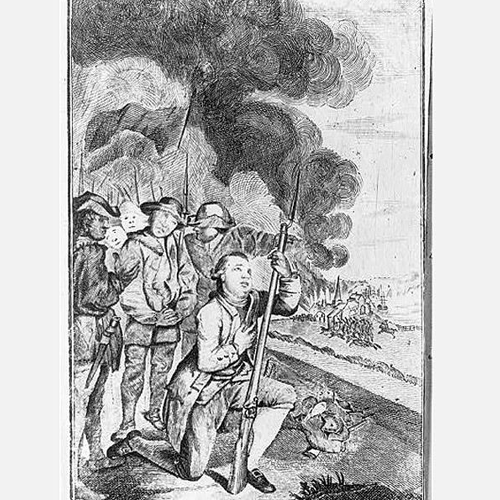
Chisholm v. Georgia: State Sovereign Immunity Prior to the 11th Amendment
Chisholm v. Georgia, 2 U.S. 419 (1793) is one of the first important decisions issued by the U.S. Supreme Court. The case, however, is not widely known or studied in constitutional law classes because its main holding, which abrogated state sover...

The Affordable Care Act Tax Credit Subsidies Are Constitutional
In King v. Burwell, a divided Court ruled that all tax subsidies granted under the healthcare law are legal. Had the Court ruled otherwise, the sweeping healthcare reform law may have been in jeopardy. The Facts of the Case The latest ACA ...

Hayburn’s Case: The Issue of Justiciability
Hayburn’s Case, 2 U.S. 409 (1792) is one of the earliest decisions of the U.S. Supreme Court. Although the Judiciary Act of 1789 authorized the creation of the Court, the justices did not consider their first case until 1792. Hayburn's case pre...
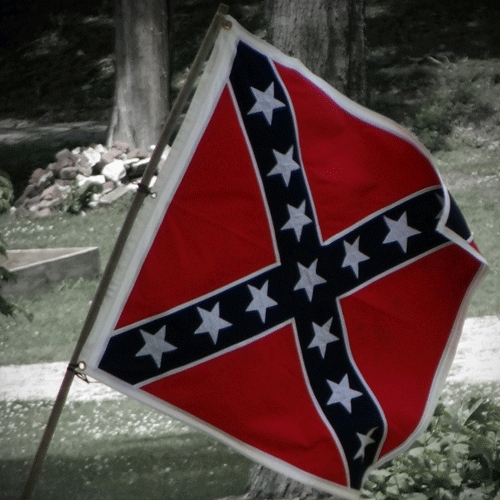
Texas Can Refuse the Confederate Flag License Plate: Walker v. Texas
In Walker v. Texas Division, Sons of Confederate Veterans, Inc., the U.S. Supreme Court held that Texas’ specialty license plate designs constitute government speech. Accordingly, Texas was entitled to refuse to issue a confederate flag license pla...
The Fourteenth Amendment and the Slaughterhouse Cases
The U.S. Supreme Court first reviewed the Fourteenth Amendment to the U.S. Constitution in the Slaughter-House Cases, 83 U.S. 36 (1873). In a 5-4 decision, the majority adopted a narrow construction of the Amendment’s Privileges and Immuniti...
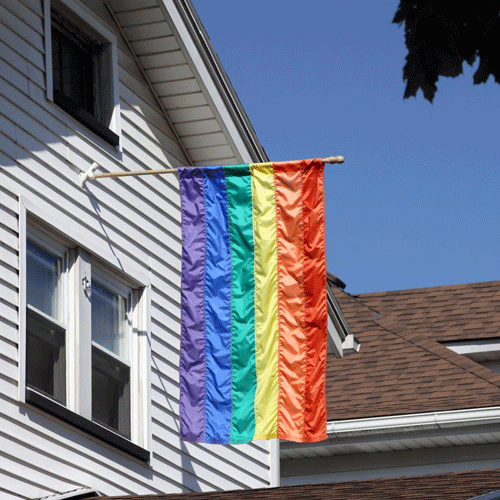
Same-Sex Marriage Affirmed in Obergefell v. Hodges
By a vote of 5-4 in Obergefell v. Hodges, the United States Supreme Court held that the Fourteenth Amendment requires a State to license a marriage between two people of the same sex and to recognize a marriage between two people of the same sex when...
Previous Articles
SCOTUS Rules State Can’t Immunize Parties from Federal Civil Liability
by DONALD SCARINCI on January 29, 2026
In John Doe v. Dynamic Physical Therapy, LLC, 607 U.S. ____ (2025) the U.S. Supreme Court held that...
Supreme Court to Address Racial Discrimination in Jury Selection
by DONALD SCARINCI on
While the U.S. Supreme Court has concluded oral arguments for the year, it continues to add cases t...
Supreme Court Halts Deployment of National Guard to Chicago
by DONALD SCARINCI on
In Trump v. Illinois, 607 U.S. ____ (2025), the U.S. Supreme Court refused to stay a district court...