
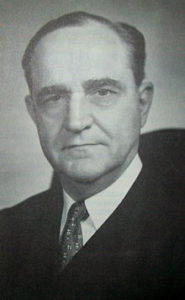
Sherman Minton (1949-1956)
Sherman Minton served on the U.S. Supreme Court as an Associate Justice from 1949 until 1956. Minton was a career politician, and the last member of Congress to be nominated to the Supreme Court. Minton maintained a broad interpretation of governmental powers while on the Court and was well-known for his ardent support of New Deal legislation while serving as a U.S. Senator.
Early Life and Legal Career
Minton was born on October 20, 1890 in Georgetown, Indiana. He attended Indiana University, graduating at the top of his class. Following college, he enrolled in the Indiana University Law School. While attending law school, Minton played on the Indiana University football team. He graduated in 1915, once again at the top of his class. Due to his impressive academic performance, Minton won a scholarship allowing him to take post-graduate courses at Yale Law School. He obtained a Master of Law degree from Yale in 1916.
After graduating, Minton moved back to Indiana, opened a law practice and began to get involved in politics. In 1917, soon after the U.S. entered World War I, he enlisted in the U.S. Army and served on the western front. Minton, however, did not see any combat. After the war, he returned to Indiana and reopened his law practice. In 1934, Minton was elected as a U.S. Senator from Indiana on a platform that was very supportive of the New Deal. He quickly befriended fellow Senate democrat, Harry Truman. As a senator, Minton was highly critical of the Republican party. He supported many of President Roosevelt’s bills, including the President’s “court-packing” provision.
On May 7, 1941, President Theodore Roosevelt appointed Minton to serve as a judge on the U.S. Court of Appeals for the Seventh Circuit. He held this position until being appointed to the Supreme Court eight years later.
Appointment to the Supreme Court
Minton was appointed to the United States Supreme Court by President Truman on October 3, 1949. During his tenure, Minton often voted with the conservative side of the court. He rarely favored judicial interference if it could be avoided. In Adler v. Board of Education, Minton authored the majority opinion, which upheld a New York statute allowing schools to fire teachers belonging to subversive groups–specifically those that advocated overthrowing of the government. In Youngstown Sheet and Tube Co. v. Sawyer, a case that held unconstitutional President Truman’s utilization of executive authority to seize steel mills where workers were striking, Minton joined in the Court’s dissenting opinion. Notably, in Brown v. Board of Education, which reversed the “separate but equal” doctrine and desegregated schools, Minton voted against the government.
Minton refused to keep his position past his ability to adequately fulfill his obligations to the Court. After serving for 7 years and 3 days, he retired due to poor health on October 15, 1956.
Death
Minton died of pernicious anemia in his hometown of New Albany, Indiana on April 9, 1965.
Notable Cases
Adler v. Board of Education (1952)
Youngstown Sheet and Tube Co. v. Sawyer (1952)
Brown v. Board of Education (1954)