
Early Life
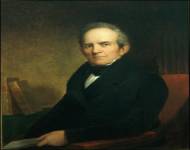
Smith Thompson was born on January 17, 1768, in Amenia, New York. Thompson earned his Bachelor’s Degree from Princeton University in 1788. He began to study law following graduation under legal scholar James Kent and was admitted to the bar in 1792. As a member of the Democratic-Republican Party, Thompson went on to practice law in Poughkeepsie, New York for the next ten years.
Political Career
In 1800, Thompson was elected to the New York State Assembly, and the following year he served as a delegate in the New York Constitutional Convention. In 1802 Thompson became a Justice on the New York Supreme Court, where he served under his former law mentor, Chief Justice James Kent.
When Kent left the state Supreme Court to become Chancellor of New York in 1814, Thompson moved into the position of Chief Justice. During his 16 years on the New York Supreme Court, Thompson was a very active member, writing approximately 250 opinions.
In 1819, President Monroe nominated Thompson as the 6th Secretary of the Navy. He served in this role for the next several years, while also campaigning for the 1824 Presidential Election. Andrew Jackson won the nomination over Thompson, however, as candidate for the Democratic-Republican Party.
Supreme Court
In 1823, President Monroe nominated Thomson to become an Associate Justice on the United States Supreme Court to fill the vacant seat of Justice Henry Brockholst Livingston. It was not until Thompson failed to earn the nomination for the 1824 Presidential Election that he reluctantly accepted the nomination to the Supreme Court. Thompson officially began his post on September 1, 1823.
Several years later Thompson once again attempted to run for political office when he entered the 1828 election Gubernatorial Election in New York. He was defeated in this campaign and remained on the bench.
During his time on the Supreme Court, Thompson became known for frequently disagreeing with Federalist Chief Justice John Marshall. Thompson’s support of States’ rights did not align with the nationalist views of the Chief Justice, and the two voting differently in many occasions.
Justice Thompson also served as a large supporter of minority interests. In the case of Worcester v. Georgia (1832), Thompson played a large role in upholding the majoring ruling that states have no criminal jurisdiction in Native American lands. This ruling formulated the basis for tribal sovereignty in the United States.
Justice Thompson’s most notable case during his tenure on the Supreme Court came in the 1841 United States v. Amistad case regarding a rebellion of Africans aboard a Spanish ship. During the case, Justice Thompson maintained that no American court had jurisdiction over the criminal charges for those on board the ship, as the ship was a foreign vessel. In the Court decision, Thompson joined Justice Story’s majority opinion that the Africans on board were unlawfully kidnapped and thus must be rightfully returned to Africa. The United States v. Amistad case gained much traction for the abolitionist movement in the U.S.
Death
Justice Thompson served on the Supreme Court until his death on December 18, 1843 in Poughkeepsie, New York at the age of 75.
Notable Cases:
Worcester v. Georgia (1832)
Kendall v. United States (1838)
United States v. The Amistad (1841)