Menu


Hot-Topics
March 12, 2026 | SCOTUS Rejects Delaware Affidavit of Merit Requirement
Tag: Eighth Amendment
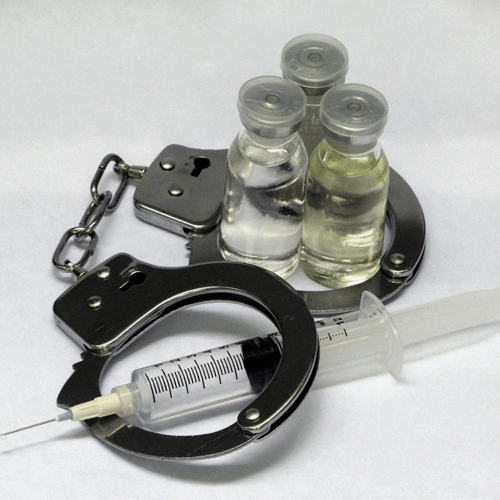
Lethal Injection Cocktail Approved in Glossip v. Gross
On June 29, 2015, the U.S. Supreme Court ruled, by a vote of 5-4, that Oklahoma’s lethal injection protocol does not violate the Eighth Amendment’s prohibition on cruel and unusual punishment. The case, Glossip v. Gross, was one of the most signi...
Grand Jury Power in Death Penalty Cases
The U.S. Supreme Court recently granted review in Hurst v. Florida, which challenges the constitutionality of a Florida law limiting the power of the jury in death penalty cases. The criminal law case raises interesting questions with regard a defen...
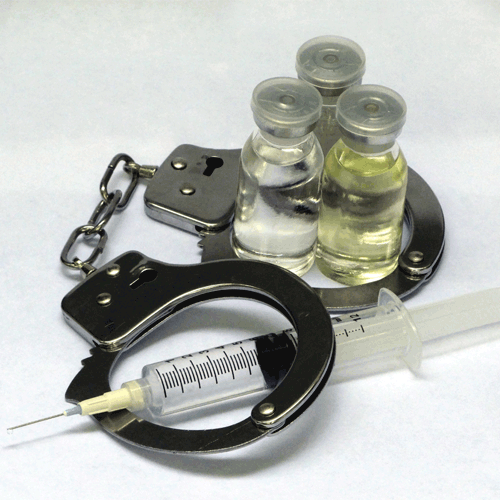
Glossip v. Gross: Supreme Court Grants Rare Death Penalty Case
Later this term, U.S. Supreme Court will consider its first death penalty case since 2007. The issue in Glossip v. Gross is whether a new sedative used in lethal injections violates the Eighth Amendment to the U.S. Constitution. The drug at use, in ...

What’s on Deck: Supreme Court May Change Execution Rules for Mentally Disabled Defendants
The U.S. Supreme Court recently agreed to revisit the issue of whether mentally disabled defendants can face the death penalty. In Atkins v. Virginia, the Court ruled that the execution of persons with mental disabilities constituted "cruel and unusu...
Previous Articles
Supreme Court Holds Candidate Can Challenge Election Law Governing Vote Counting
by DONALD SCARINCI on March 6, 2026
In Bost v. Illinois State Board of Elections, 607 U.S. ___ (2026), the U.S. Supreme Court held that...
Supreme Court Hold Ex Post Facto Clause Applies to Criminal Restitution Statute
by DONALD SCARINCI on
In Ellingburg v. United States, 607 U.S. ____ (2026), the U.S. Supreme Court unanimously heldthat t...
SCOTUS Reaffirms Fourth Amendment Standard for Police Responding to Household Emergencies
by DONALD SCARINCI on February 19, 2026
In Case v. Montana, 607 U.S. ____ (2026), the U.S. Supreme Court confirmed thatthe Fourth Amendment...