
Constitutional Law Reporter
Award
Menu
  • Home
  • US Constitution
  • Supreme Court Cases
  • Justices
    • Chief Supreme Court Justices
    • Current Supreme Court Justices
    • Past US Supreme Court Justices
  • American Biographies
    • General
    • Presidents
    • Vice-Presidents
    • First Ladies
    • Signers of the U.S. Constitution
    • Signers of the Declaration of Independence
    • Delegates of the U.S. Constitution
    • Misc – Great American Bios
  • Articles
    • Current Cases
    • Historical Cases
    • Impeachment
  • Videos
  • Links
Hot-Topics

December 24, 2025 | Supreme Court Allows Texas to Use Challenged Congressional Map

A B C D E F G H I J K L M N O P Q R S T U V W X Y Z
<< Back

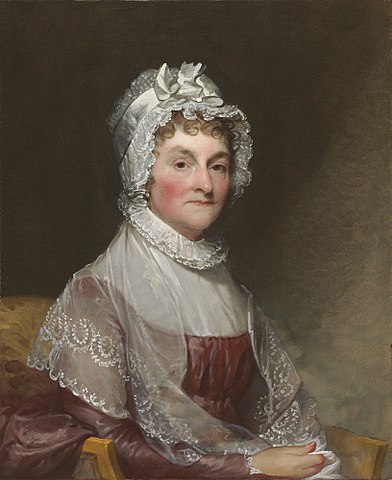
Abigail Smith Adams

Abigail Smith Adams
By Gilbert Stuart – National Gallery of Art, Washington, D. C., online collection, Public Domain, https://commons.wikimedia.org/w/index.php?curid=18223293

Abigail Smith Adams was the wife of second president John Adams and the mother of sixth president John Quincy Adams. As her husband worked to secure the colonies’ independence, frame a new government, and lead the country, Abigail was one of his most influential advisers.

Early Life

Abigail Smith Adams was born on November 22, 1744, in Weymouth, Massachusetts. While she did not receive formal schooling, she learned to read and write. She also enjoyed English and French literature.

On October 25, 1764, Abigail married John Adams, and the couple would go on to have six children. Throughout the course of their marriage, the couple exchanged letters, which would later be published by their grandson and give Americans unique insight into the early days of our country.

John and Abigail were often separated, as he travelled as a circuit judge and later to attend the Continental Congress. In addition to raising the children, Abigail managed the family’s farm and business affairs. In 1776, Abigail wrote to her husband, who was attending the First Continental Congress, and famously told him to “remember the ladies.” She added, “Do not put such unlimited power into the hands of the husbands. Remember all men would be tyrants if they could.”

After the Revolutionary War, John Adams served as a diplomat. Abigail accompanied him to his posts in Paris and then London. They both returned home in 1789 so John could serve as vice president to George Washington.

First Lady of the United States

When John Adams was elected President in 1796, Abigail took an active role in his administration, even earning the nickname Mrs. President. Abigail, who was accustomed to speaking her mind, had trouble adjusting to her new role as First Lady. “I have been so used to freedom of sentiment that I know not how to place so many guards about me, as will be indispensable, to look at every word before I utter it, and to impose a silence upon myself, when I long to talk,” she wrote.

When the capital was relocated from Philadelphia to Washington, D.C. in 1800, Adams became the first First Lady to live in the White House. She continued to host formal dinners and events, even though the White House was far from completion and located in the wilderness.

Later Life

AAfter John lost his re-election bid in 1801, the Adams family returned to Massachusetts. Abigail died on October 28, 1818, at the age of 73. Her son, John Quincy Adams, was elected president in 1824.


Previous Articles

Justices Skeptical of Trump Administration Tariffs
by DONALD SCARINCI on December 18, 2025

The U.S. Supreme Court heard oral arguments in Learning Resources, Inc. v. Trump (consolidated with...

Read More
SCOTUS Takes Up Key Election Case Involving Mail-In Ballots
by DONALD SCARINCI on December 17, 2025

The U.S. Supreme Court recently granted certiorari in a key election case, Watson v. Republican Nat...

Read More
SCOTUS Adds Second Amendment Case to Docket
by DONALD SCARINCI on November 27, 2025

The U.S. Supreme Court will consider another important Second Amendment case this term. The latest ...

Read More
All Posts

The Amendments

  • Amendment1
    • Establishment ClauseFree Exercise Clause
    • Freedom of Speech
    • Freedoms of Press
    • Freedom of Assembly, and Petitition
    Read More
  • Amendment2
    • The Right to Bear Arms
    Read More
  • Amendment4
    • Unreasonable Searches and Seizures
    Read More
  • Amendment5
    • Due Process
    • Eminent Domain
    • Rights of Criminal Defendants
    Read More

Preamble to the Bill of Rights

Congress of the United States begun and held at the City of New-York, on Wednesday the fourth of March, one thousand seven hundred and eighty nine.

THE Conventions of a number of the States, having at the time of their adopting the Constitution, expressed a desire, in order to prevent misconstruction or abuse of its powers, that further declaratory and restrictive clauses should be added: And as extending the ground of public confidence in the Government, will best ensure the beneficent ends of its institution.

Read More

More Recent Posts

  • Supreme Court Clarifies Applicability of First Step Act to Vacated Sentences
  • SCOTUS Rules E-Cigarette Retailers Can Challenge FDA Order in Fifth Circuit
  • Supreme Court Expands Judicial Review of Agency Actions
  • Supreme Court Pauses Order Reinstating CPSC Commissioners

Constitutional Law Reporter Twitter

A Twitter List by S_H_Law

Constitutional Law Reporter RSS

donald scarinci constitutional law attorney

Editor

Donald Scarinci

Managing Partner

Scarinci Hollenbeck

(201) 806-3364

Awards


Follow me

© 2018 Scarinci Hollenbeck, LLC. All rights reserved.

Prior results do not guarantee a similar outcome. Attorney Advertising