

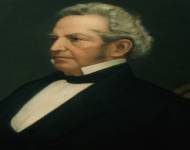
Early Life
James Moore Wayne was born in 1790 (exact date unknown) in Savannah, Georgia. After spending his childhood in Georgia, Wayne left his hometown to attend Princeton University, graduating in 1808. He returned to Savannah shortly afterward to study law. Wayne was admitted to the bar in 1810 and began a private practice shortly afterward.
Early Career
During the War of 1812, Wayne volunteered as an officer in the Georgia cavalry. Over the next decade, Wayne served brief terms in a number of different positions in Georgia. He worked as a member of the George State House of Representatives from 1815 to 1817, Mayor of Savannah from 1817 to 1819, and a judge of the Savannah Court of Common Pleas from 1819 to 1822.
During the years of 1822 to 1828, Wayne maintained his private practice while serving as a judge on Superior Court of Georgia. In 1829, following the election of President Andrew Jackson, Wayne was elected as a member of the Jacksonian Party to serve in the United States House of Representatives.
Supreme Court
In 1835 President Jackson nominated Wayne to the United States Supreme Court to fill the vacant seat of Justice William Johnson. Wayne resigned from his position on the U.S. House of Representatives and officially began his post on the Supreme Court on January 14, 1835.
In Wayne’s early years as Justice, the Supreme Court went through a time of great transition. Chief Justice John Marshall’s death in July 1835 led to the appointment of Chief Justice Roger Taney, a strong supporter of Jacksonian Democracy. In addition, President Jackson’s six appointments to the Supreme Court during the 1930s radically changed the dynamic of the Court.
During his tenure on the Supreme Court, Justice Wayne became known for his involvement in Admiralty Law, taxation, and legal issues regarding acquired land from foreign nations. In the case of Cooley v. Board of Port Wardens of Philadelphia (1852), Wayne issued a dissent, arguing that U.S. Congress ought to be the only entity with power to regulate interstate commerce.
Leading up to the Civil War, all Justices on the Supreme Court including Wayne dealt heavily with matters concerning slavery. In the case of Prigg v. Pennsylvania (1842), Justice Wayne supported the majority opinion, maintaining that only Congress may determine legal actions against runaway slaves.
The most important case during Wayne’s time on the Supreme Court came in the 1857 Dred Scott v. Sandford hearing. During the case Wayne played a large role in the majority opinion that Congress had no power to interfere with slavery due to the Due Process Clause of the Fifth Amendment, thus upholding the legality of slavery. This decision ultimately fueled the dispute leading the Civil War.
During the Civil War, Justice Wayne received much criticism for his decision to remain on the Supreme Court. Although he wished to serve the interests of his home state of Georgia, he did not support the legality of succession and became the only southern representative on the Supreme Court during this time period.
Death
In 1866, a year before Justice Wayne’s death, Congress passed the Judicial Circuits Act, effectively reducing the number of seats on the Supreme Court from ten to seven. Wayne’s vacant seat thus was not filled.
Justice Wayne died on July 5, 1867 in Washington, D.C., from a severe fever. His thirty-two year tenure on the Supreme Court is among the longest in Court history.
Notable Cases:
Prigg v. Pennsylvania (1842)
Cooley v. Board of Port Wardens of Philadelphia (1852)
Dred Scott v. Sandford (1857)