
US Supreme Court Sides With Marijuana User in Second Amendment Case
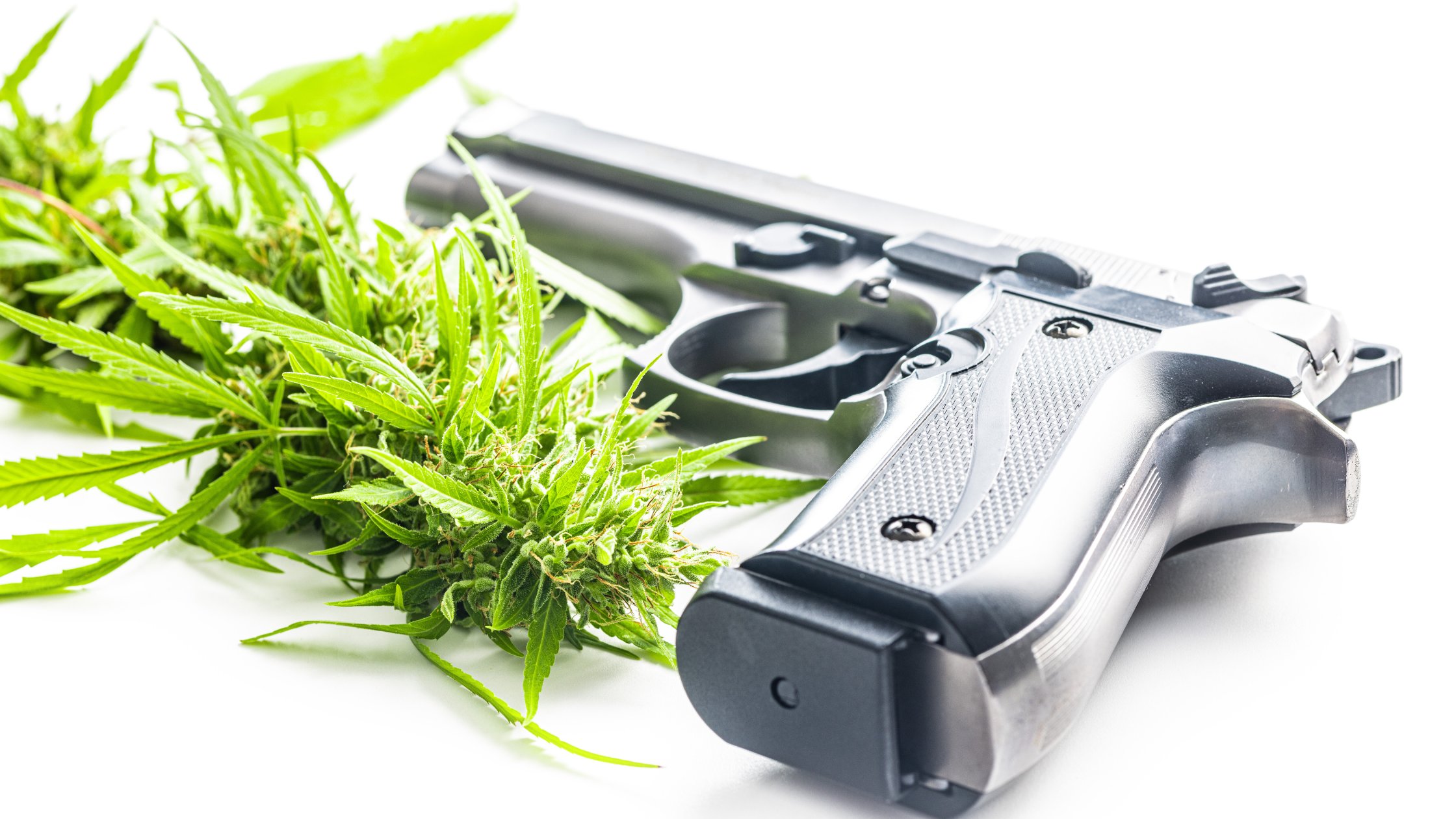
In United States v. Hemani, 608 U.S. ___ (2026), the U.S. Supreme Court unanimously held that the federal government’s prosecution of a nonviolent marijuana user for possessing a gun violated the Second Amendment’s right to bear arms.
Facts of the Case
Ali Hemani is a dual citizen of the United States and Pakistan who was born in Texas. He has spent most of his life living in the Dallas area with his parents and working a stable job. Suspecting Mr. Hemani and his family members of terrorism-related activities, the government conducted a search of the family home in 2022. Throughout the process, Mr. Hemani proved cooperative: he surrendered a gun he kept in the house, pointed agents to some marijuana on the property, and consented to an interview during which he told law enforcement months after the search.
Relying solely on Mr. Hemani’s admitted use of marijuana, the government prosecuted Mr. Hemani under 18 U.S.C. §922(g)(3) for knowingly possessing a gun in his home while being an unlawful user of a controlled substance. Mr. Hemani moved to dismiss the indictment, arguing that the government’s effort to enforce §922(g)(3) against him violated the Second Amendment. The district court granted the motion, and after an unsuccessful appeal to the Fifth Circuit, the government asked this Court to review the case.
Supreme Court’s Decision
The Supreme Court unanimously held that “the government’s prosecution of Mr. Hemani under §922(g)(3)’s unlawful user provision is inconsistent with the Second Amendment.” Justice Neil Gorsuch wrote on behalf of the Court.
As Justice Gorsuch explained, while the Second Amendment protects the right of all Americans to keep and bear firearms for self-defense, it does have limits. As set forth in New York State Rifle & Pistol Assn., Inc. v. Bruen, 597 U.S. ____ (2022), to determine when the government infringes the Second Amendment, the Court begins by asking whether the Amendment’s terms cover the conduct in question; if so, the Constitution “presumptively” protects it. To overcome that presumption, the government bears the burden of showing its regulatory efforts are “consistent with the Nation’s historical tradition of firearm regulation.” However, as the Court clarified in United States v. Rahimi, 602 U.S. 680 (2023), the government need not point to a “historical twin” or “precis[e] . . . historical precursors.”
Applying this framework, the Supreme Court went on to conclude that §922(g)(3)’s unlawful user provision burdens conduct presumptively protected by the Second Amendment because the statute bans a class of people, including Mr. Hemani, from possessing essentially any firearm for any purpose.
To allow “the government that kind of ‘broad power to designate any group as dangerous and thereby disqualify its members from having a gun,'” Justice Gorsuch wrote, “would risk allowing it to ‘quickly swallow’ the Second Amendment.”
In reaching its decision, the Court rejected the government’s reliance on habitual drunkard laws to justify §922(g)(3)’s unlawful user provision. “The habitual drunkard laws on which the government relies here differ dramatically from [the federal] unlawful user provision on every single metric the government invites us to consider,” Justice Gorsuch wrote. “They targeted different kinds of people, did so for different purposes, and operated in different ways. Whether any one of these problems taken in isolation would prove fatal to the government’s cause, we need not decide. Taken cumulatively, we hold, they certainly do.” Justice Gorsuch went on to note that “apart from pointing to habitual drunkard laws, the government has not even attempted to prove that any other specific historical principle might justify its prosecution in this case.”
Finally, the Court emphasized that itsdecision was narrow. Notably, it did not apply to laws that ban addicts or those presently intoxicated from possessing a firearm, or other laws “Congress might adopt after determining that users of a particular drug pose a special risk of misusing firearms.”
In an unusual pairing, Justice Samuel A. Alito Jr. authored a concurrence joined by Justice Elena Kagan. The justices agreed with the Court’s decision, but wrote separately to emphasize that the government could not compare historical laws dealing with drunkards to present efforts to bar guns from marijuana users.
“Marijuana use today is like alcohol use at the founding,” Justice Alito wrote. “It is widespread and increasingly considered socially acceptable in many quarters. And from a practical standpoint, law enforcement widely tolerates the use of marijuana.”
Previous Articles
Supreme Court Clarifies Constitutionality of Tax Foreclosure Sales
by DONALD SCARINCI on September 28, 2026
In Pung v. Isabella County, 609 U.S. ____ (2026), the U.S. Supreme Court held that the proper basel...
Supreme Court Closes Door on Judicially Created Claims Under Alien Tort Statute
by DONALD SCARINCI on September 21, 2026
In Cisco Systems, Inc. v. Doe, 609 U.S. ___ (2026), the U.S. Supreme Court ruled that federal cour...
US Supreme Court Upholds “Metering” Policy for Asylum Seekers
by DONALD SCARINCI on September 15, 2026
In Mullin v. Al Otro Lado, 609 U.S. ___ (2026), the U.S. Supreme Court held that an alien standing ...