Menu


Hot-Topics
October 12, 2026 | Supreme Court Rules Prison Officials Can’t Face RLUIPA Suit
Tag: double jeopardy

New Supreme Court Term Kicks Off with Oral Arguments in Five Cases
The U.S. Supreme Court’s new term gets into full swing next week. To kick off the new Supreme Court term, the justices will hear oral arguments in five cases, along with issuing orders and a meeting to consider additional cert petitions. ...

October 2016 Supreme Court Term Preview: Major Criminal Cases at Hand
The U.S. Supreme Court will return from its summer recess at the end of the month. The justices have already agreed to consider a number of significant criminal law cases over 2016-2017 Term. This post offers a brief preview. Bravo-Fer...
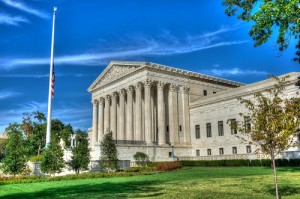
SCOTUS up to 47 cases for 2015-16 Term Docket
The Supreme Court (SCOTUS) kicked off its new term on October 5, 2015 and filled about 2/3 of its docket. In total, SCOTUS granted certiorari in thirteen new cases during its September 28 long conference, bringing the docket to 47. Last term th...

NFIB v. Sebelius: ACA Survives First Constitutional Challenge
In NFIB v. Sebelius, 567 US __ (2012), the U.S. Supreme Court considered its first constitutional challenge to the Affordable Care Act. By a vote of 5-4, the Court held that the statute’s “individual mandate” provision was a valid exercise of C...

Barron ex rel. Tiernan v. Mayor of Baltimore: The Limits of the Bill of Rights
In Barron ex rel. Tiernan v. Mayor of Baltimore, 7 Pet. 243 (1833), the U.S. Supreme Court held that the Bill of Rights placed limits on the national government and not on state governments. The Court, in an opinion written by Chief Justice John ...
Previous Articles
Supreme Court Clarifies Constitutionality of Tax Foreclosure Sales
by DONALD SCARINCI on September 28, 2026
In Pung v. Isabella County, 609 U.S. ____ (2026), the U.S. Supreme Court held that the proper basel...
Supreme Court Closes Door on Judicially Created Claims Under Alien Tort Statute
by DONALD SCARINCI on September 21, 2026
In Cisco Systems, Inc. v. Doe, 609 U.S. ___ (2026), the U.S. Supreme Court ruled that federal cour...
US Supreme Court Upholds “Metering” Policy for Asylum Seekers
by DONALD SCARINCI on September 15, 2026
In Mullin v. Al Otro Lado, 609 U.S. ___ (2026), the U.S. Supreme Court held that an alien standing ...