Menu


Hot-Topics
March 12, 2026 | SCOTUS Rejects Delaware Affidavit of Merit Requirement
Tag: armed services
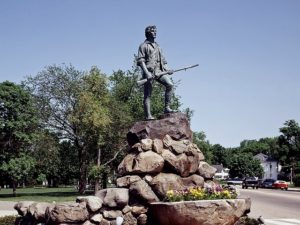
Wayman v Southard: The Limits of Non-delegation
In Wayman v Southard, 23 U.S. 10 Wheat. 1 1 (1825), the U.S. Supreme Court first grappled with the doctrine of non-delegation, under which one branch of government can’t delegate its constitutionally authorized power to another. In the decision, Ch...
Ware v Hylton: Supreme Court Power to Invalidate State Laws
Ware v Hylton: Supreme Court Power to Invalidate State Laws In Ware v. Hylton, 3 U.S. (3 Dall.) 199 (1796), the U.S. Supreme Court held that the federal courts are authorized to determine the constitutionality of state laws. The Court subsequently h...

U.S. V. O’Brien: Symbolic Speech and the First Amendment
In United States v. O'Brien, 391 U.S. 367 (1968), the U.S. Supreme Court upheld the constitutionality of a federal law that made burning or otherwise destroying draft cards a crime. In so ruling, the Court established a test for determining whether l...
Boumediene v. Bush: Constitutional Rights of Guantanamo Detainees
In Boumediene v. Bush, 553 U.S. 723 (2008), the U.S. Supreme Court addressed the rights of foreign citizens detained at the U.S. Naval Base at Guantanamo Bay, Cuba. By a vote of 5-4, the Court held that in Boumediene v. Bush the detainees ha...
Previous Articles
Supreme Court Holds Candidate Can Challenge Election Law Governing Vote Counting
by DONALD SCARINCI on March 6, 2026
In Bost v. Illinois State Board of Elections, 607 U.S. ___ (2026), the U.S. Supreme Court held that...
Supreme Court Hold Ex Post Facto Clause Applies to Criminal Restitution Statute
by DONALD SCARINCI on
In Ellingburg v. United States, 607 U.S. ____ (2026), the U.S. Supreme Court unanimously heldthat t...
SCOTUS Reaffirms Fourth Amendment Standard for Police Responding to Household Emergencies
by DONALD SCARINCI on February 19, 2026
In Case v. Montana, 607 U.S. ____ (2026), the U.S. Supreme Court confirmed thatthe Fourth Amendment...